Monday, April 24, 2006

Zen koan as a sword parry

As I was reading "The Unfettered Mind" by Takuan Soho, I noticed that the author makes an analogy between a sword parry and a Zen koan. Here are some relevant bits from "The Mysterious Record Of Immovable Wisdom":

if the mind stops with the sword with which a man is going to strike you, there will be an interval, and your own action will be lost. But if in the interval between your opponent's striking sword and your own action you cannot introduce even the breadth of a hair, your opponent's sword should become your own.

and then:

In Zen, if asked, "What is the Buddha?" one should raise a clenched fist. If asked, "What is the ultimate meaning of the Buddhist Law?" before the words have died away, one should respond, "A single branch of the flowering plum" or "The cypress in the garden".
It is not a matter of selecting an answer either good or bad. We respect the mind that does not stop. The non-stopping mind is moved by neither color nor smell.

Sunday, April 02, 2006

"Aikido is generally believed to represent circular movements. Contrary to such belief, however, Aikido, in its true Ki form, is a fierce art piercing straight through the center of opposition.
The nature of the art being such that you are not supposed to adapt to your partner by making a wide oblique turn of your body but are called upon to find your way onward while twisting your hips."

- Saito Morihiro , Traditional Aikido, Vol. 5

Sunday, February 26, 2006

Ordering

1. Hands are last.
2. Hips before hands.
3. Feet before hips.
Now, what to do with Kokkyo? Is it is always there?

Friday, February 10, 2006

Which founder?

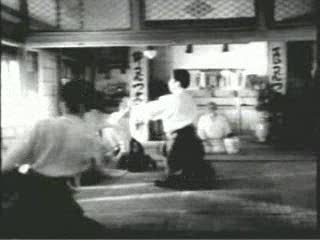
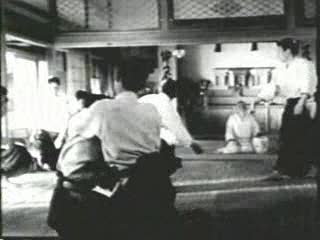
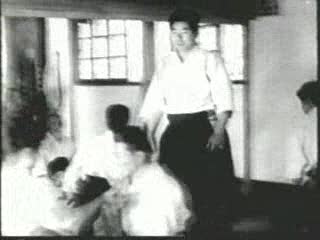
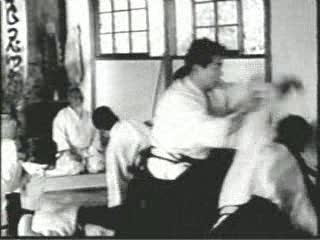
When one searches Google images for 'osensei' ,the resulting images can be classified as "old sage" and "virile budo master".

The ratio is about 30:1 in favor of the "old sage". I think that this is a cultural choice which also reflects the popular interpretation of Aikido.

Here is my contribution to the popular vote: and another one:

Saturday, January 28, 2006

What did the old man want you to be doing?

An interesting discussion on aikidojournal following a quote from an interview with Shimizu Kenji:

"When I was actively practicing there he often came and went. When he showed up everyone immediately sat down. At first, I thought that people were being courteous toward him. However, it wasn't only that. It was also that the practices we were doing were different from what O-Sensei expected us to do. Once he lost his temper at us. No one realized that he had come and he shouted: "What you people are doing is not aikido."

This was in Hombu dojo in 1963, and I wander if there was dojo of which the Founder would have approved.

Maybe the one next to his house in Iwama, were he would actually sit, and observe the lessons conducted by Saito Morihiro?


How does it feel to teach Aikido, while being watched by the Founder himself?


Also, how does it feel to learn Aikido, while being watched by the Founder himself?

Friday, January 06, 2006

The Myth of Zen in the Art of Archery

The 'Zen in the Art of Archery' by Eugen Herrigel is fascinating book. Do not read it though, without reading the 'The Myth of Zen in the Art of Archery' article by Yamada Shoji (a freely available PDF). Hers is a direct link, and this is a google search.
The book describes the spiritual enlightenment of the author as he progresses through kyujutsu studies in 1930s Japan.

The article, on the other hand, describes Herrigen as a person who came to Japan to pursue all things Zen. Not having a solid grasp on the language or the cultural context of his studies, Herrigen sees Zen everywhere. The fact that his teacher "...had no experience in Zen nor did he unconditionally approve of Zen..." has no bearing whatsoever on Herrigen's perception of reality.

These two, are very relevant reading for people who try to make sense of Aikido. They post warning signs all over the place. Just replace kyujutsu with Aikido and Eugen Herrigel with your name, and you are all set.
 
Blog directory